
Can Millets Boost Fertility? The Science Behind India's Most Powerful Ancient Grains
- Sana Firdous
- Mar 24
- 8 min read

Updated: Mar 26

How Jowar, Khapli, Foxtail and Little millet support hormonal balance, PCOS, and natural conception — the science behind India's oldest superfoods.
IN THIS ARTICLE
Do Millets Boost Fertility? Why Ancient Grains Are Gaining Attention
Fertility is not just about biology — it's about nurturing your body, balancing your hormones, and nourishing yourself with the right foods. As modern couples face growing challenges around conception and reproductive health, many are turning back to India's time-honoured grains for answers.
Among these, ancient millets like jowar (sorghum), bajra (pearl millet), foxtail millet, and little millet are quietly reclaiming their deserving spotlight. Once the foundation of Indian diets for centuries, these humble grains are now being validated by science as powerful allies for reproductive health.
The evidence is clear: millets boost fertility by addressing the root causes
of hormonal imbalance, poor egg quality, and low sperm health. Research shows
that regular millet consumption can meaningfully improve fertility outcomes
in both men and women within 8-12 weeks.
The secret lies not in any single nutrient, but in the remarkable combination of low glycemic index, dense micronutrition, antioxidant content and prebiotic fiber — all working together to create the hormonal environment your body needs to thrive.

Hormone Balance Starts With Balanced Blood Sugar
Most people don't realise that reproductive hormones and blood sugar are deeply connected. When blood sugar spikes — as it does with refined grains, white rice and processed foods — insulin surges, and that surge disrupts the delicate signalling between the brain, ovaries and adrenal glands.
This is where millets deliver their most powerful fertility benefit: a consistently low glycemic index.
By digesting slowly and releasing glucose gradually, millets prevent the insulin spikes that interfere with oestrogen production, progesterone levels, and the hormonal triggers behind ovulation. For women trying to conceive — especially those with PCOS or irregular cycles — this stabilising effect can be genuinely transformative.
The Insulin-Fertility Link: Elevated insulin directly raises androgen (male hormone) levels in women, disrupting ovulation and cycle regularity. A low-GI diet built around millets is one of the most evidence-supported dietary strategies for improving fertility outcomes.
This is the core mechanism of why millets boost fertility so effectively.
When you stabilize blood sugar, you stabilize hormones. When you stabilize
hormones, you create the optimal conditions for ovulation, sperm production,
and successful conception. Studies demonstrate that women who switch to a
millet-based diet see measurable improvements in cycle regularity within
4-6 weeks, and men see improvements in sperm parameters within 8-12 weeks.
How Millets Boost Fertility: Key Nutrients for Reproductive Health
This is why millets boost fertility so powerfully — they deliver a complete
nutritional package. Rather than a single nutrient, millets provide the
entire constellation of vitamins, minerals, and phytonutrients that work
synergistically to support reproductive health.
Millets are among the most micronutrient-dense staple grains available in India. Unlike refined wheat or polished rice — which lose most of their nutrition during processing — millets deliver their full nutritional payload in every serving.
Here are the five fertility-critical nutrients millets provide, and exactly what each one does for your reproductive health:
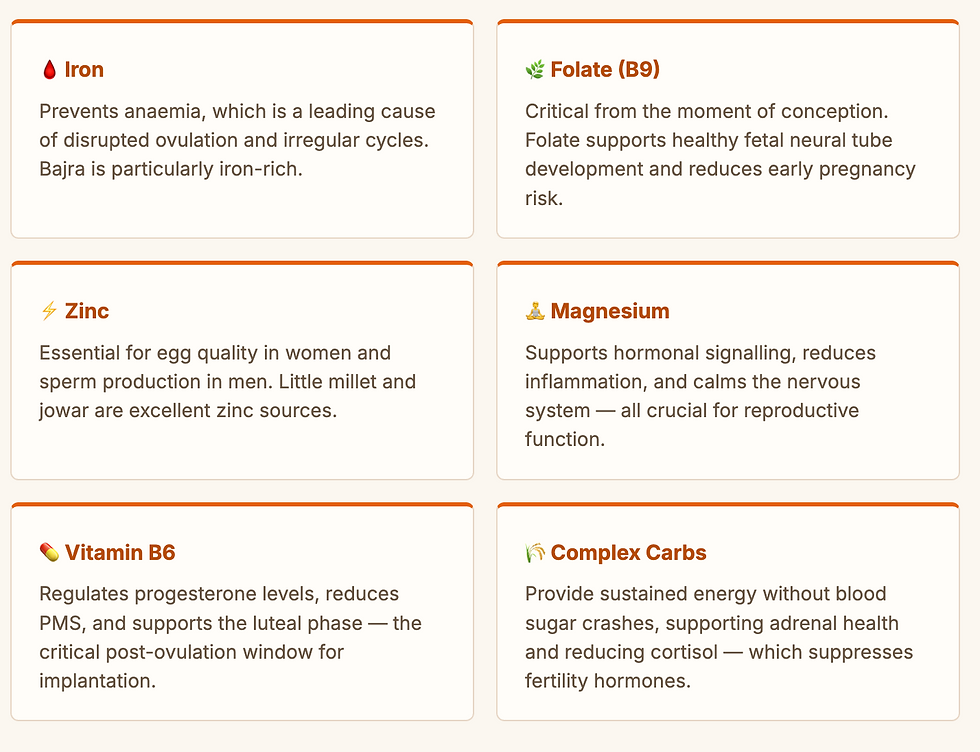
Antioxidant Power: Protecting Your Eggs and Sperm
One of the lesser-known but most important factors in fertility is oxidative stress — the cellular damage caused by free radicals. Oxidative stress is known to reduce egg quality in women and sperm quality in men, and it's increasingly linked to unexplained infertility.
Millets are rich in polyphenols, a class of plant antioxidants that neutralise free radicals before they can cause cellular damage. This protection extends directly to the reproductive cells — keeping eggs and sperm healthier, and supporting the conditions needed for successful fertilisation and implantation.

Foxtail millet, in particular, has been noted for its anti-inflammatory polyphenol content, while little millet offers a broad spectrum of antioxidant micronutrients that protect sperm DNA integrity.
"Ancient Indian wisdom always embraced millets for building vitality at every stage of life. Today, science is confirming what our grandmothers always knew."
Gut Health, Detoxification & Hormonal Harmony
Your gut and your hormones are in constant conversation. A healthy gut microbiome is essential for metabolising and eliminating excess hormones — particularly oestrogen. When gut health is compromised, oestrogen can be reabsorbed back into the bloodstream, contributing to hormonal imbalance.
The high dietary fiber in millets acts as a prebiotic, feeding beneficial gut bacteria and encouraging regular bowel movements that support hormonal detoxification. This fiber also slows digestion, improving the absorption of the very micronutrients — zinc, magnesium, B vitamins — that are so critical for fertility.
Gut-Hormone Connection: Research shows that a diverse gut microbiome directly influences oestrogen metabolism, inflammation levels, and even stress hormone regulation — all of which shape your fertility window.
Special Benefits for Women: PCOS, Irregular Cycles & Fertility
For women navigating PCOS, irregular periods, or challenges with conception, millets offer a uniquely comprehensive dietary solution — addressing multiple root causes simultaneously rather than just managing symptoms.
Millets for PCOS Management
PCOS (Polycystic Ovary Syndrome) is driven largely by insulin resistance and chronic low-grade inflammation. The low glycemic index of millets directly addresses insulin resistance, while their anti-inflammatory polyphenols and magnesium content help reduce the systemic inflammation that underlies PCOS.
Regular millet consumption has been associated with reduced visceral fat — the abdominal fat that is most strongly linked to worsened PCOS outcomes and fertility challenges. Even modest reductions in visceral fat can restore ovulation in women with PCOS.
Regulating Cycles Naturally
✓Stable blood sugar from low-GI millets supports consistent hormonal signalling throughout the menstrual cycle
✓Iron from bajra prevents the anaemia that disrupts ovulation and shortens luteal phase
✓Magnesium reduces PMS symptoms and supports the hormonal shift at ovulation
✓B6 supports progesterone production in the second half of the cycle — essential for implantation
✓Fiber aids oestrogen clearance through the gut, preventing the hormonal dominance that disrupts cycles
Did You Know? Studies suggest that replacing just one refined grain meal per day with a millet-based alternative can meaningfully improve insulin sensitivity within 8–12 weeks — one of the most impactful dietary changes for PCOS management.
How Millets Boost Male Fertility: Sperm Quality, Count & Motility
For men seeking to improve fertility naturally, millets boost sperm health
through multiple mechanisms — not just one nutrient, but a comprehensive
nutritional approach.
Fertility is a two-person equation, and millets benefit male reproductive health just as powerfully as female. Poor sperm quality — whether in count, motility, or morphology — is now identified as a contributing factor in nearly half of all infertility cases, and nutrition is one of the most modifiable influences on sperm health.
Zinc | in little millet and jowar is directly involved in testosterone production and sperm cell development |
B vitamins | support sperm DNA integrity and reduce the risk of fragmentation that leads to failed fertilisation |
Polyphenol antioxidants | protect sperm cells from oxidative damage, improving both count and motility |
Magnesium | supports healthy testosterone levels and reduces inflammation that can impair sperm production |
Low GI carbohydrates | maintain healthy body weight, which is closely correlated with sperm quality |
Quick Reference: Which Millets Boost Fertility Most? Jowar, Bajra & More
MILLET VARIETY | KEY NUTRIENTS | PRIMARY FERTILITY BENEFIT |
Jowar (Sorghum) | Zinc, Magnesium, Polyphenols | Low GI, hormone balancing, gut health support |
Bajra (Pearl Millet) | Iron, B9 (Folate), Magnesium | Prevents anaemia, promotes ovulation & blood flow |
Little Millet | Zinc, B Vitamins, Antioxidants | Egg & sperm quality, DNA integrity, oxidative protection |
Foxtail Millet | B6, Iron, Polyphenols | Steady energy, reduced inflammation, cycle regulation |
All Millets | Dietary Fiber, Complex Carbs | Prebiotic gut support, oestrogen metabolism, detox |
Khapli (Emmer Wheat) | Complex Carbs, Fiber, Polyphenols | Low GI alternative to regular wheat; aids insulin stability, key for conditions like PCOS |
Easy Ways to Add Millets to Your Daily Fertility Diet
The best fertility diet is one you can actually maintain. Millets are remarkably versatile — they slot into Indian cooking naturally and can replace refined grains in almost every meal without compromising on taste or texture.

Morning
✓Millet porridge with nuts, seeds and a drizzle of honey — a hormone-supportive, low-GI start to the day
✓Jowar or bajra upma in place of semolina
✓Little millet dosa or idli — traditional and effortless to prepare
Lunch & Dinner
✓Replace white rice with cooked jowar or foxtail millet alongside your usual dal and sabzi
Comfort Reimagined: Try the Maize & Peppers Bucato (Rice Shape)—a nutrient-dense, grain-free alternative that mimics the texture of rice in your favorite comfort dishes like pulao or curd rice.
✓Millet rotis using bajra or jowar flour instead of refined maida.
Try our Khapli wheat pasta- a superior alternative to maida-based pasta for your fertility goals.
✓Warm millet grain bowls with roasted vegetables, legumes and a tahini dressing

Start Simple: You don't need to overhaul your entire diet at once. Even replacing one refined grain meal per day with a millet-based alternative begins to shift your blood sugar patterns, gut microbiome and hormonal environment within weeks.
The bottom line: millets boost fertility when you make them a consistent
part of your diet. You don't need perfection — just consistency. Start with
one millet-based meal per day, and within 8-12 weeks, you'll likely see
meaningful improvements in energy, mood, cycle regularity (if female), or
sperm parameters (if male). This is the kind of dietary change that pays
dividends for years.
Frequently Asked Questions
Can millets actually boost fertility?
Yes — millets boost fertility through multiple mechanisms. They like jowar,
bajra, foxtail and little millet are rich in iron, folate, zinc, magnesium
and antioxidants — nutrients that directly support reproductive health. Their
low glycemic index helps stabilize blood sugar and hormones, which is
essential for regular ovulation and healthy conception. Studies show that
women and men who incorporate millets into their daily diet see meaningful
improvements in fertility markers within 8-12 weeks. The key is consistency —
making millets a regular part of your diet, not just an occasional choice.
Which millet is best for PCOS and Hormonal imbalance?
Jowar (sorghum) and foxtail millet are particularly beneficial for PCOS due to their low glycemic index and anti-inflammatory properties. Bajra is excellent for iron levels and ovulation support. A combination of millets in your daily diet provides the most comprehensive hormonal benefit.
Do millets help with male fertility and sperm quality?
Yes. Little millet and bajra contain zinc, B vitamins and antioxidants that support healthy sperm count, motility, and DNA integrity. These nutrients reduce oxidative stress — one of the leading nutritional contributors to poor sperm quality and male infertility.
How quckly do millets improve hormonal health?
Studies suggest measurable improvements in insulin sensitivity and blood sugar stability within 8–12 weeks of consistent millet consumption. Hormonal changes can follow over the subsequent months, especially when millets replace refined grains rather than simply being added to an existing diet.
Are millets better than rice and wheat for fertility?
For fertility specifically, millets outperform white rice and refined wheat significantly. They have a lower glycemic index, more micronutrients per serving, higher antioxidant content, and more prebiotic fiber — all of which contribute to the hormonal balance and cellular health that support conception.
Ready to Support Your Fertility with Ancient Grains?
If you're ready to incorporate millets and ancient grains into your diet, Rootistri's Khapli wheat pasta is an easy, delicious way to start. Made from 100% pure cold-pressed Khapli (emmer) wheat with just 3 ingredients, our pasta delivers the same fertility- boosting benefits discussed in this post — low GI, high fiber, and dense micro-nutrition. Browse our full product range to find the best ancient grain options for your fertility journey.
📚 Sources & References
Mithaahara — Advantages of Eating Millets for Fertility
Dr. Mona Dahiya — Improve Fertility Naturally by Eating Little Millet
The Health Site — Millets for Managing PCOS
Hills Natural — Incredible Health Benefits of Millets
Ready to Nourish Your Fertility?
Bring the power of ancient Indian millets to your table with Rootistri — where tradition meets nutritional science.


Comments